China shifts from price taker to price maker in global derivatives markets: FOW Asia 2026
24th September, 2026
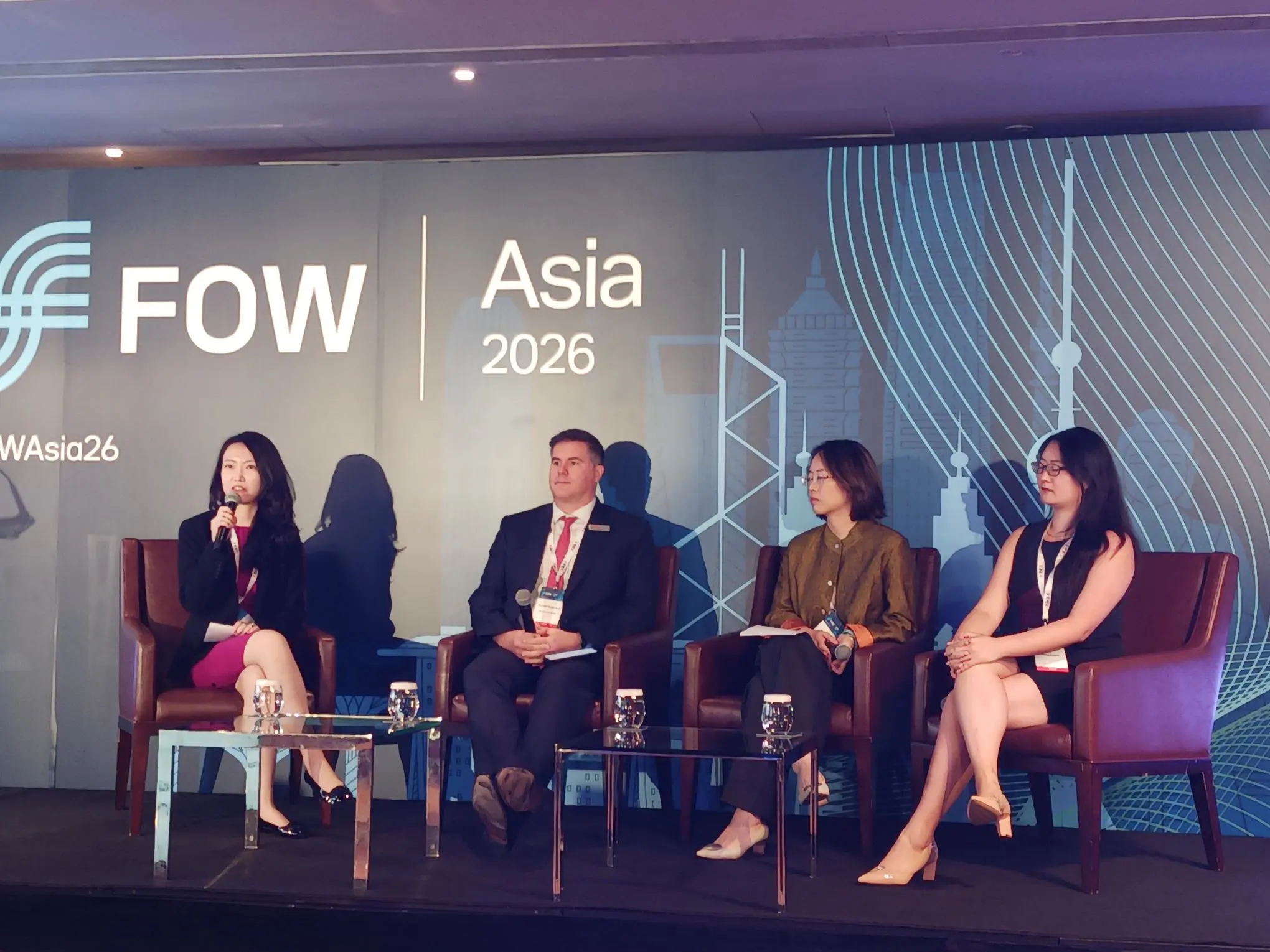
As China takes on an increasingly important role in global derivatives markets, further market access enhancements will be a key enabler for international growth.
Speaking at the FOW Asia 2026 conference in Hong Kong on Thursday, panellists explored how international access to Chinese derivatives markets are evolving.
Shuangwen Li, international business - senior institutional sales at Huatai Futures, said that connectivity is no longer the bottleneck but clients are asking questions about how to post margin and execute more efficiently.
“From physical products to forex and derivatives, China exposure is part of a global portfolio rather than just one product,” said Li.
She highlighted that liquefied natural gas has become a focus with interest coming from the largest importers, refiners, utilities and industrial users.
“This is driving greater demand for transparent price discovery linked to the Chinese market and tools are needed to manage risk exposure to demand and price changes,” she said.
For a product to be globally relevant, physical market coverage, liquidity and collateral management are key.
She added: “Price movement is leading in the East as China becomes more dominant in the physical market as it shifts from price taker to price maker.”
Russell Robertson, chief business development officer at Abaxx Exchange & Clearing, highlighted the interest in critical minerals, particularly in lithium carbonate which is offered as an internationally delivered contract on Abaxx and is benchmarked in China on the Guangzhou Futures Exchange.
“While the China Securities Regulatory Commission is internalising products, the biggest challenge remains how to move dollars around and whether international participants want to use the RMB,” he said.
With the Middle East conflict, there has been continued disruption in price discovery for oil, energy and critical minerals.
“Coupled with rising commodity consumption, investors will buy at a price that’s relevant,” he said. “China has the opportunity to become a controller in price, especially given the change in commodity flow and pricing where buyers are looking more towards the East for price discovery.”
Shirley Chen, head of quants and qualified foreign investor, global business division at Orient Futures, reflected on the rapid growth of the Chinese derivatives sector in the first half of 2026, driven by institutionalisation and international integration.
Total volume reached 5 billion and turnover saw $72 trillion, with over 60% institutional investors. The chemical sector saw volume of 1. 4 billion, driven by methanol and PTA. The precious metals segment, fueled by gold and silver, reached turnover of $6.9 trillion and $7.5 trillion respectively. For the non-ferrous market, copper and nickel were popular products.
While overseas participation has been purely directional before, Chen said that the expansion of products has created a significant shift to the relative value and arbitrage, and interest in cross border arbitrage pairs, for instance, INE and ICE crude oil.
Arbitraging price spreads, managing basis risk and using options for tailored hedging strategies demonstrate how the market has become more mature.
From a product internationalisation perspective, for the wholly owned foreign enterprise (WFOE) route, there are 38 in total, including 20 commodities futures and 18 options.
For Qualified Foreign Investors (QFI), 118 out of 170 products have opened up, including 98 speculative products and 20 that are hedging only financial derivatives.
While WFOEs can trade all listed products, eligibility for QFI is complicated as it involves a licence and onshore bank account opening.
For the overseas intermediaries (OI) route, which requires less operational requirements, it can be used as an alternative while investors prepare for a QFI licence.
From a margin perspective, the OI route requires US dollar for collateral while QFI and WFOEs need to convert to RMB.
“Although trading and connectivity are clear, the most friction for international investors is that there’s no direct market access,” said Chen. “They need to go to brokers that require regulatory compliance checks.”
A recent new rule for futures companies adds further complexity on accessing external information systems, due diligence and system checking.
“These complications add complexity to clients who are struggling to get certificates onshore,” said Chen. “From a cross border funding perspective, it takes time to wire money to onshore and convert to RMB.”
An additional challenge are the fragmented rules between Chinese exchanges as they have different ways of controlling the market, with changes that are often released and implemented on the same day.
Chen pointed to the importance of capital efficiency improvement and despite the Chinese regulator’s encouragement for investors to use the RMB, many don’t hold Chinese government bonds onshore.
While total return swaps remain the most commonly used for international investors, the regulator still wants investors to choose the QFI/OI route as they offer more transparency.
Related topics
Related Articles
All Insights25th September, 2026
New York sues Polymarket over alleged illegal gambling
The lawsuit adds another front to a widening US dispute over whether event contracts should fall under federal derivatives oversight or state gambling laws.
Narayani Srinivasan

25th September, 2026
OG.com to seek CFTC nod for perpetual single stock futures
The filing signals intensifying competition around perpetual equity products, as regulated venues look to replicate the flexibility of crypto derivatives within the US futures framework.
Narayani Srinivasan

25th September, 2026
Bullish, Equiniti explore issuer-sponsored tokens via new industry collaboration
The digital assets platform has formed a multi-stakeholder industry working group called the ‘Issuer Sponsored Token Coalition,’ in collaboration with UK-based registrar and transfer agent (RTA) Equiniti to advance issuer-sponsored tokenised securities.
Aravind Bulusu